Project Jai
The AI capability inside the JointAction Platform.
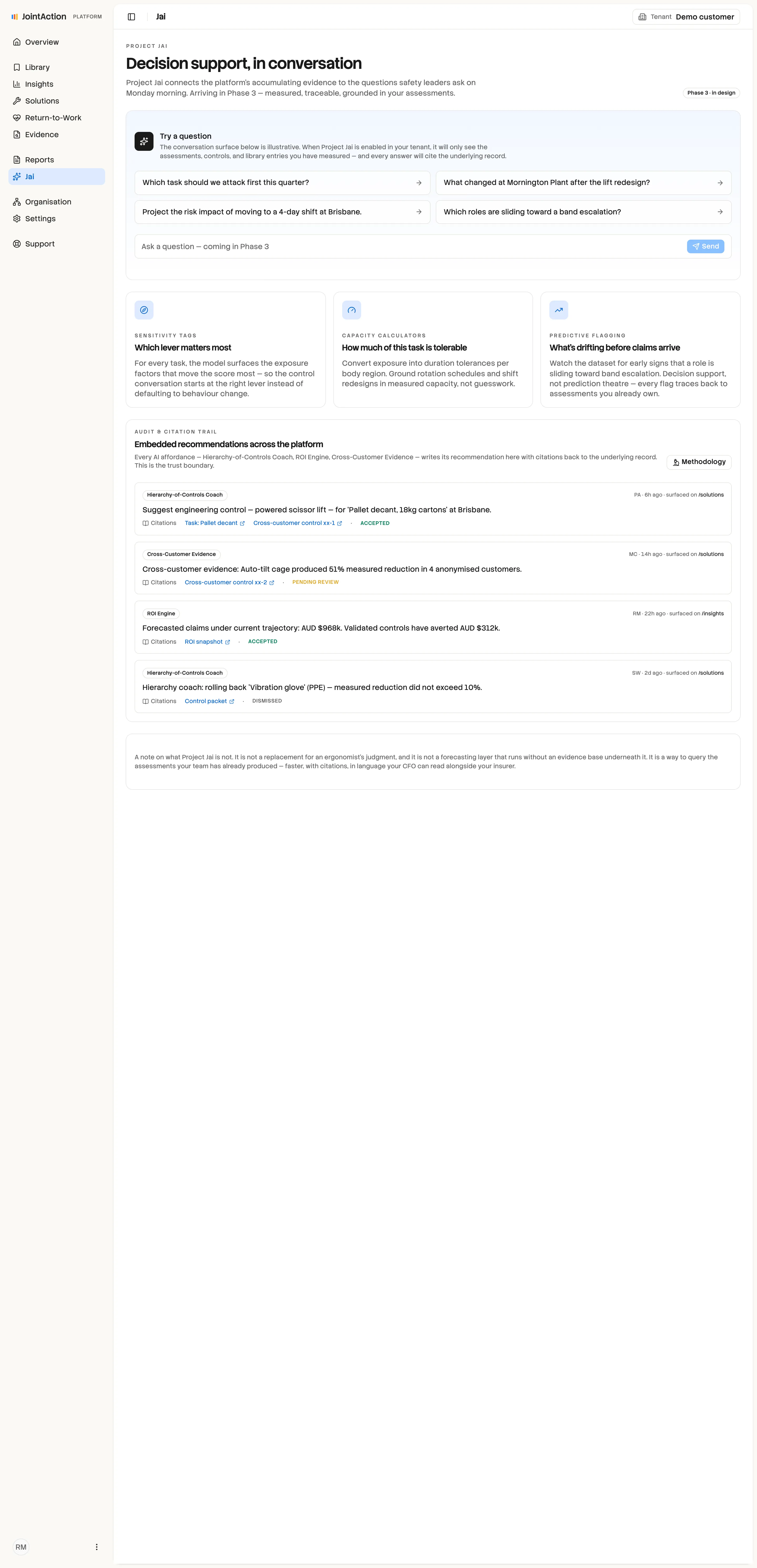
Natural-language reporting, decision support, sensitivity profiling, capacity calculation and exposure forecasting — operating on the platform's accumulating evidence. Customer data used for training is anonymised and non-identifiable; customer opt-out is supported.
What it is
The platform's evidence, made operationally accessible.
Project Jai works on top of the platform's assessment evidence and methodology to produce operationally-useful outputs — not a separate product, not an add-on. Project Jai is the interface; the methodology is the substance.
Natural-language reporting
Narrative summaries of an assessment, a control, a role-level risk profile or a longitudinal trend — ask in plain English, get a structured answer drawn from your data.
Natural-language querying
Interrogate your task library, control history and risk landscape with plain-English prompts — inside your own access controls.
Sensitivity profiling
Classify each assessed task by its dominant risk driver — duration-, frequency- or posture-dominant — and its proximity to a band transition.
Capacity calculation
Compute the maximum allowable task time, cumulative loaded time or repetition count under a chosen risk threshold.
Risk-landscape visualisation
Heatmap the risk score across the duration × frequency exposure space, surfacing the operational decision space at a glance.
Exposure forecasting
Flag tasks and roles approaching risk-band boundaries before they cross them — from fragility profiles and operational change signals.
Named workflow
One workflow you'll call by name.
Hierarchy-of-Controls Coach
Flags when a proposed control sits low on the hierarchy and surfaces higher-hierarchy alternatives — engineering, substitution, elimination — drawn from the Cross-Customer Evidence Library, with a full audit trail.
What it isn't
Bounded on purpose.
Not AI safety advice
It doesn't give individual workers behavioural recommendations. The work is the problem, not the worker.
Not a black box that replaces the methodology
It works on top of the Consequential Risk Score's outputs — it doesn't substitute a learned-from-data score for the methodology's structure.
Not a clinical decision-making system
It doesn't diagnose, prognosticate or replace medical judgement on a worker's return-to-work clearance.
Not a marketing aura
Where AI is mentioned, it's named directly, described by what it does, and bounded by its governance posture.
Data governance
The structural commitments behind every AI conversation.
Anonymised & non-identifiable
Customer data used to train any platform-level AI is anonymised — worker identifiers and customer-identifying metadata are removed before training.
Customer opt-out
Customers may opt their data out of training use. Opt-out is preserved as a structural commitment.
No cross-customer leakage
A query of your data never returns another tenant's data. Cohort and benchmarking outputs are explicitly de-identified and run above minimum-cohort thresholds.
Grounded & auditable
Outputs reproduce the score's structure and cite their inputs; the platform records the input, the request and the output, so you can inspect what Project Jai was given and what it produced.
Conversations it supports
Five questions, answered from your own evidence.
The safety leader
“Out of 50 assessed tasks across our three sites, which ones should we attack first?”
Sensitivity and fragility profiles return a sorted list — with the reasoning behind the order.
The CFO
“Show me the program's last twelve months in language I can use in the board update.”
A natural-language summary of the longitudinal record, anchored in the platform's data.
The insurer's risk advisor
“Where is this customer's risk profile heading over the next twelve months?”
Exposure forecasting surfaces the trajectory under the current operational pattern.
The ergonomist
“What's the highest-leverage change for this duration-dominant, fragility-high task?”
The capacity calculator and sensitivity profile structure the question; the Coach surfaces higher-hierarchy controls.
The leadership team
“We're considering a 10% staffing reduction at one site — what does that do to our risk profile?”
Project Jai surfaces the projected impact on capacity limits and band-transition risk.