Workplace MSD prevention platform
Reduce musculoskeletal injuries. With evidence.
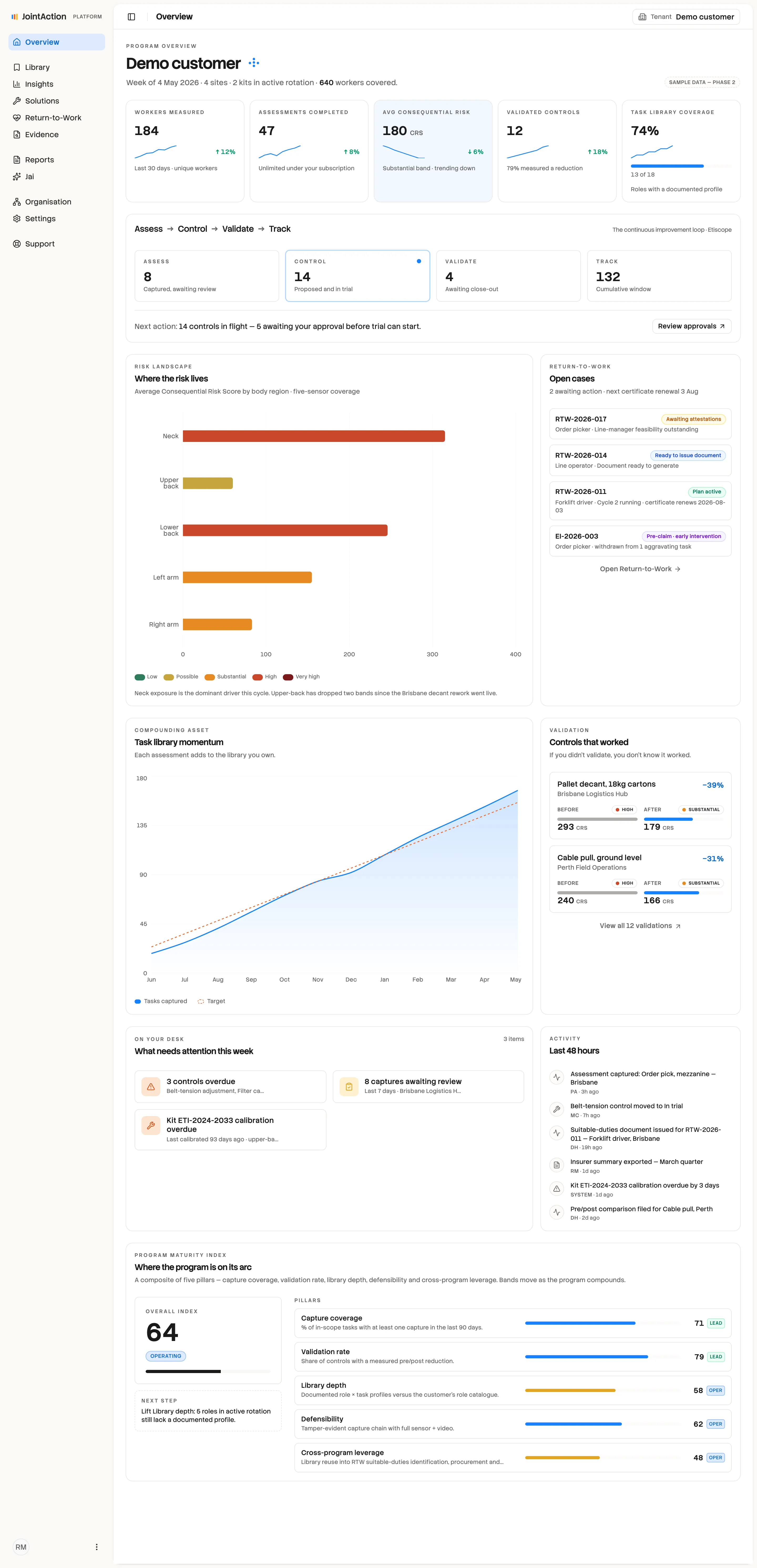
JointAction is the solutions and intelligence layer that turns objective, sensor-derived assessment evidence into a compounding prevention asset: a documented task demands library, suitable duties matched against real role demands, a risk universe across every site and shift, validated controls, and a regulator-ready evidence base.
Evidence in, intelligence out. Illustrative figures.
RTW Matchmaker · the first customer module, in development
When a worker is injured, know which duties are safe — in minutes.
RTW Matchmaker is the platform’s first customer module, in development now. It will draw on the physical demands of every task in the worker’s role: the return-to-work coordinator will record the medical certificate’s restrictions, and the platform will identify the suitable duties — no guesswork, no negotiation over vague “modified duties,” no waiting on a site visit. Return-to-work matching against documented role demands is delivered today as an engagement on top of your task demands library.
The Victorian mandate
Victoria’s Workplace Injury Rehabilitation and Compensation Amendment Act 2025 requires employers to give return-to-work coordinators “the tools, systems, and assistance” to do the job — with obligations commencing by 1 July 2027 and penalties up to 120 penalty units for individuals and 600 for corporations.
Return-to-work matching against documented role demands is delivered today as an engagement on top of your task demands library. How the RTW Matchmaker module is packaged will be confirmed at release.
Per-task verdicts
The certificate’s restrictions, judged against the measured demands of every task in the worker’s own role — each marked suitable or unsuitable, with the evidence attached.
A document, not a portal
The output is a concise, evidence-backed suitable-duties proposal the worker takes to their treating doctor. Doctors never log in to anything.
Graduated return, replanned on renewal
Progressive schedules on regular review cycles, matched to the certificate-of-capacity cadence — plus a pre-claim pathway that pulls workers off aggravating tasks before an injury becomes a claim.
The JointAction Platform
The layer that turns assessment evidence into prevention.
JointAction takes the objective evidence captured in the field and turns it into a compounding asset your prevention program owns. RTW Matchmaker is the first customer module out of the gate, in development now — behind it, the strength is the layer as a coherent whole.
Task & job insights
What the data implies about specific tasks and aggregated roles, surfaced across every site and every shift.
Task demands library
A documented profile of the physical demands of every important role — built once, drawn on for years.
Return-to-work matching
Certificate restrictions judged against per-task demands — an evidence-backed suitable-duties document for the treating doctor, not ambiguous “modified duties.” Delivered today as an engagement on top of your task demands library.
The risk universe
Portfolio-level visualisation of musculoskeletal risk across the whole organisation.
Validation evidence
The same task, before and after a control, measured the same way — proof a change worked.
Project Jai
The platform’s AI capability: natural-language reporting, decision support and exposure forecasting.

Etiscope · how the evidence gets in
The assessment product the platform runs on.
Etiscope is how customers capture physical-work risk — five inertial measurement unit (IMU) sensors, an iPad capture app, around 10 minutes per assessment, scored by the patent-protected Consequential Risk Score. Its Assess → Control → Validate → Track cycle is one workflow inside the platform.
01 · Assess
Five inertial measurement unit (IMU) sensors, the actual workplace, the actual conditions. Around 10 minutes per assessment.
02 · Control
The body-region breakdown points to the lever; decisions move up the hierarchy of controls.
03 · Validate
The same task, same protocol, after the control. Pre and post, side by side.
04 · Track
Trends across sites, tasks and time, with overdue controls flagged.

Why JointAction
Built for a risk that's never one thing.
Objective by design
Sensor-derived measurement. Two assessors get the same numbers — built for the field, not the lab.
Consequence-weighted
The Consequential Risk Score weights exposure by injury severity, recovery pathway and claims-cost data — so it reflects which task will hurt someone, not just which angle crossed a threshold.
Connected, not single-point
Musculoskeletal disorder (MSD) risk is multi-factorial — how load, posture, repetition, duration and recovery combine, against the worker and how the work is organised. The platform connects the whole lifecycle — assess, control, validate, track — instead of ending at one number.
Compounds with usage
The platform builds a coherent intelligence layer you own. The longer your program runs, the deeper the asset gets.
Whole-of-workforce
Every worker — not just the ones lifting.
Etiscope handles the physical workforce. MoveTime is a parallel path for sedentary and desk-based workers — a desktop application, available to download, with organisation and site licences, and separate from the manual-handling stack. Together, at the JointAction Platform’s enterprise tier, they cover every worker an organisation employs.
Project Jai
Inside the platform, Project Jai turns the same assessment evidence into natural-language reporting, decision support and exposure forecasting — with customer data anonymised and opt-out by design.
In short
Founded in Mornington, Victoria
Countries: Australia, United States, United Kingdom
Per Etiscope field assessment
Patents behind the Consequential Risk Score